
How are new cannabis strains created? Cannabis breeding is a careful process of selecting parent plants, making controlled crosses, evaluating offspring, and repeating selection until desirable traits become consistent. This guide explains how breeders create new strains and cultivars, from genetics, phenotyping, and marker-assisted selection to backcrossing, cloning, stabilization, and testing. It also covers the practical considerations and growing goals that help turn a promising cross into reliable weed seeds or an elite clone.
This article is written for advanced readers who already understand the basics of cannabis cultivation and plant genetics. If you are new to breeding, start with our beginner’s guide to breeding cannabis from seed to strain for a more accessible introduction to the core concepts and workflow.
The strongest modern cannabis breeding programs are built around two facts. First, some traits have identifiable major-effect loci that are useful for early marker-assisted selection, including sex, cannabinoid chemotype, and flowering-time. Second, many of the traits that matter most in commerce—yield, morphology, terpene output, disease response, and absolute cannabinoid concentration—are still quantitative and strongly shaped by environment. That is why the best programs combine genetics, careful phenotyping, sanitation, and multi-environment testing rather than relying on folklore, strain names, or one “silver bullet” technique.
Each breeding tool solves a different problem in the process of creating a new cannabis cultivar:
- Seed breeding creates new allele combinations.
- Cloning preserves a finished genotype.
- Tissue culture helps maintain, clean, and multiply elite clones, but it does not replace recombination-based breeding.
- Marker-assisted selection speeds traits with clean genetic signals.
- Backcrossing is good for moving one trait into a preferred background.
- Selfing or other inbreeding schemes reduce segregation over generations.
- Hybridization creates new combinations and can recover useful transgressive phenotypes.
- Polyploidy is promising but inconsistent; in cannabis, it changes morphology reliably, but chemical outcomes are cultivar-dependent and often do not improve in a straight line.
If you need only one operational rule, use this one: breed from verified, clean, well-documented parents, and evaluate offspring in the environment where they are meant to perform. If you are comparing genetics for a grow project, browse USEED’s cannabis seed bank and match the seed type to your cultivation goal. The biggest causes of failure are mislabeled genetics, accidental pollination, weak records, small selection populations, pathogen carryover in clone lines, and selection in one environment that does not predict performance in the real target environment.
Understanding genotype, phenotype and heritability

A breeder works with a few basic ideas. Genotype is the genetic makeup a plant carries. Phenotype is what you can observe or measure: height, flowering time, THC percentage, terpene profile, powdery mildew symptoms, inflorescence shape, and so on. A plant’s phenotype is not produced by genes alone. It is the result of genotype filtered through environment and management. In cannabis, that matters immediately because the same line can shift in appearance and phytochemical profile across sites, seasons, and cropping systems.
Dominant and recessive are useful concepts, but they only explain part of cannabis breeding. A dominant allele can mask a recessive allele in a heterozygote. Some cannabis traits do behave roughly like major-gene traits. The mapped PM1 powdery mildew resistance locus behaves as a dominant resistance factor in the reported backgrounds, while the mapped Autoflower1 locus is tied to the autoflower trait that breeders had long described as a simple recessive pattern. Those are the exception that proves the rule: many economically important cannabis traits are not single-switch Mendelian traits.
Heritability asks the breeder’s key question: how much of the variation I see is genetic enough to respond to selection in this population and this environment? It is not a fixed property of a trait in all places and all populations. In controlled-environment medicinal cannabis work, plant height and days to maturation showed relatively high heritability, while other production traits were more context-dependent. Commercial breeders make the same point in applied language: environment can visibly shift plant performance, so trials have to be run in target environments to separate genetic signal from site noise.
One more principle matters for stabilization. Repeated self-pollination reduces heterozygosity by about half each generation. That is why inbred seed lines take multiple generations to settle down, while clone-only releases can preserve an elite genotype immediately once it is found. Cannabis complicates this because the crop is commonly dioecious and many commercial lines have been maintained clonally, but the underlying logic is the same.
Below is the cannabis breeder’s mental model of phenotype formation and selection. For a related look at how growers make selections from a population, see pheno hunting cannabis.

This loop is the core of every serious cannabis breeding program, whether the immediate goal is a CBD line, an early outdoor finisher, a disease-resistant mother line, or a clone-only release.
Breeding goals
Cannabis breeders usually optimize a trait bundle rather than just a single trait. The most common goals are chemotype, terpenes, yield, flowering behavior, disease resistance, and plant architecture. The exact bundle depends on the business model: flower, extraction, seed, fiber, grain, or mixed-use hemp. Official DUS systems for cannabis/hemp already reflect this reality by using traits such as flowering time, sex expression, plant height, and inflorescence THC and CBD content as key grouping characters.
For THC/CBD profiles, the breeder usually cares about two different questions. The first is ratio: will the line reliably produce mostly THC, mostly CBD, or mixed chemotype? Modern marker work made that question much easier because sex and cannabinoid chemotype can be screened early with high-throughput assays, and earlier work on chemotype markers laid the foundation for this. The second question is absolute concentration: how much THCA, CBDA, CBGA, or total cannabinoids does the plant accumulate in a real production system? That second question is harder because it behaves more like a quantitative breeding problem.
For terpene profiles, the rule is even harsher: do not trust names, marketing categories, or aroma memory alone. Recent ploidy and phenotyping studies show that volatile outcomes can shift sharply by genotype and environment, and effects that look simple in one family may not repeat in another. That makes terpene breeding inherently measurement-heavy. Gas or LC-based chemistry, replicated trials, and strong sample identity control matter more than lore.
For yield, breeders want floral biomass, biomass partitioning, manageable structure, and reliable crop timing. Recent controlled-environment work found floral bud dry weight positively associated with plant height and stem diameter, not with later maturation per se. A broad phenotypic survey of 176 drug-type accessions also found that yield correlated negatively with maturity-related traits and positively with fresh biomass. Those are exactly the kinds of relationships a breeder uses to build a selection index rather than chasing one metric at a time.
For disease resistance, cannabis is finally moving from anecdote to mapped loci. Powdery mildew is one of the crop’s most persistent production problems, and at least two dominant resistance loci—PM1 and PM2—have now been reported. That is a major shift, because it turns resistance from a vague “good room behavior” claim into something that can be tracked genetically. At the same time, sanitation is still essential. Reviews on cannabis disease pressure and hop latent viroid make clear that pathogens can erase breeding gains if propagation systems are sloppy.
For flowering time and morphology, breeders usually want very specific deployment traits: early outdoor finish, photoperiod sensitivity, day neutrality, height, internode spacing, branch angle, inflorescence density, and sex expression. Flowering time is especially consequential because it changes biomass accumulation, harvest timing, and in regulated hemp systems can interact with compliance testing windows. Major-effect flowering loci such as Autoflower1 and Early1 make this one of the most useful areas for marker-assisted breeding today.
Breeding methods
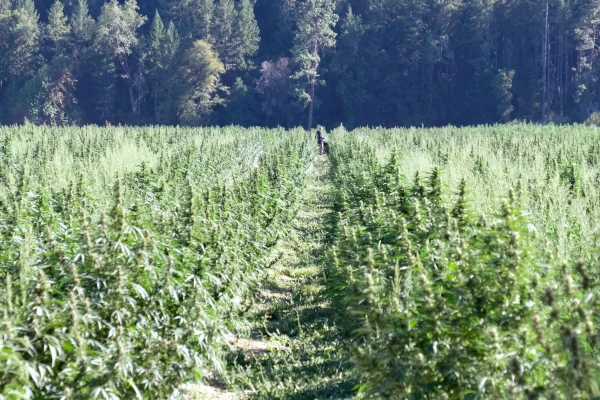
Classical cannabis breeding still starts with selection. Selection means choosing the best plants from variation that already exists within a seed lot, within a cross, or within a more structured population. Selection can be individual, family-based, clonal, recurrent, or index-based. It is the base layer underneath every other method.
Backcrossing is the method for “I like almost everything about parent A, but I need one trait from parent B.” That one trait may be chemotype, flowering time, disease resistance, or some structural feature. Backcrossing works best when the donor trait has a strong genetic signal and a good marker or a clean phenotype. General breeding theory explains why repeated backcrosses recover more of the recurrent parent genome each cycle, and cannabis marker work shows why this is now practical for some high-value targets such as chemotype, sex, and flowering time.
Inbreeding and selfing are how breeders reduce segregation and approach true-breeding seed lines. In selfing systems, heterozygosity drops by half each generation. Cannabis complicates this because many valuable plants are clonally maintained and because selfing often uses masculinized female plants rather than ordinary male–female mating. Even so, the purpose is the same: expose recessives, reduce hidden variation, and make offspring more predictable. Male-flower induction studies confirm that female cannabis plants can be induced to produce viable pollen that can be used in seed production.
Hybridization is the method for making new combinations. It can be broad, like crossing divergent pools to capture complementary traits, or narrow, like a test cross between nearly fixed parents. The best-known cannabis “families” were created this way: by combining divergent material, then selecting hard for plants that offered a better combination of finish time, architecture, chemistry, and consistency than the source populations alone.
Polyploidy is not exactly a shortcut to “more everything.” In cannabis, recent work shows reproducible changes in leaf and plant size with ploidy shifts, but chemical effects are mixed. One study on drug-type cannabis found that total cannabinoids and major cannabinoids often decreased in higher ploidy classes, with terpene responses varying by cultivar. Another study in a CBG-dominant industrial hemp background found reduced fertility in triploids and tetraploids, plus some gains in inflorescence traits in that specific background.
Marker-assisted selection is currently one of the biggest real upgrades in cannabis breeding. Where the genetic architecture is simple enough, markers let breeders screen seedlings before flowering. This is already useful for sex, cannabinoid chemotype, and major flowering-time loci. It is much less powerful for diffuse, polygenic traits unless the marker set is large and the training data are strong.
Tissue culture and cloning solve a different problem from seed breeding. Clones preserve an elite genotype exactly. Tissue culture can multiply that genotype at scale, maintain germplasm in less space, help build clean stock programs, and support future transformation or genome-editing workflows. Commercial breeders also use it to back up elite material while selection proceeds in seed-derived populations. But tissue culture is not a substitute for repeated recombination and selection when the goal is to create a genuinely new seed line.
Breeding methods compared
| Method | Core idea | Best use | Main upside | Main downside |
|---|---|---|---|---|
| Selection | Pick the best plants from variation already present | Any program | Universal and cheap to start | Slow if records and phenotyping are weak |
| Backcrossing | Repeatedly cross toward a preferred parent while retaining a donor trait | Introgressing one major trait into a strong background | Efficient when the target trait is clear | Can drag linked unwanted alleles |
| Inbreeding / selfing | Repeated selfing or close inbreeding to reduce segregation | Building stable seed lines and parent lines | Predictable offspring over time | Inbreeding depression and exposure of weak recessives |
| Hybridization | Cross distinct parents to create new combinations | New terpene or chemotype combinations, adaptation, vigor | Creates recombination and novel trait bundles | Early generations segregate heavily |
| Polyploidy | Change chromosome number | Experimental morphology, fertility, chemistry, seedlessness questions | Can alter fertility and architecture fast | Effects are highly genotype-dependent |
| Marker-assisted selection | Use DNA markers to screen seedlings | Sex, chemotype, flowering-time loci, some resistance loci | Saves space and time | Weak value for diffuse polygenic traits |
| Clonal selection | Keep and multiply a finished elite genotype | Clone-only releases, mother stock | Immediate uniformity | No reshuffling, narrow diversity |
| Tissue culture | In vitro multiplication and preservation of elite material | Clean stock, scale-up, storage, transformation support | High multiplication and germplasm security | Up-front lab cost and genotype-specific recalcitrance |
This comparison reflects cannabis-specific evidence on chemotype markers, flowering-time markers, polyploid response, and tissue-culture propagation, together with standard breeding logic on backcrossing and selfing.
Workflow for creating a new strain
A serious cannabis breeding project starts with planning, not just pollen. The breeder first defines the target as a specification sheet: legal threshold or license type, production system, intended latitude or indoor regime, chemotype, terpene goal, finish window, disease package, yield target, architecture, and release format. A project aimed at greenhouse extraction hemp is not the same as one aimed at premium indoor flower.
Next comes parent selection. Good parents are not just famous names. They are verified, clean, and trait-informative. In practice, that means stable IDs, chemistry data, disease observations, flowering-time records, and if possible marker data for sex, chemotype, or major flowering loci. Many commercial “strain” names are too unreliable to serve as breeding information on their own. That is why accomplished programs work from internal accession numbers, clone backups, and measured trait records rather than from menu labels.
Then comes the controlled cross. The breeder makes a defined mating, assigns a cross ID, preserves backup copies of each parent, and stores all metadata. The first growout asks a narrow question: did the cross create the expected variation? If the answer is yes, the second and third generations do the real work. An F2 or other segregating generation exposes recombination, rare trait combinations, and hidden recessives. This is usually the stage with the heaviest phenotyping and the highest cull rate.
From there, the breeder chooses a route. If the goal is a clone-only release, the program may stop once an elite genotype is identified, validated, and backed up clonally. If the goal is a stable seed line, the breeder usually cycles through selfing, family selection, or backcrossing while checking chemistry, flowering, disease behavior, and morphology each generation. The reason this takes time is straightforward: seed lines must become predictable, and predictability only emerges after repeated cycles of selection against segregation.
When the line begins to look coherent, the program shifts to uniformity and stability testing. In formal systems, a variety must be distinct from known comparators, sufficiently uniform for its propagation mode, and stable over repeated propagation. Official guidance for cannabis/hemp already distinguishes different expectations for cross-pollinated, vegetatively propagated, and feminized seed-propagated material. In other words, “stable enough” depends in part on what you are releasing.
This is the practical breeding loop:
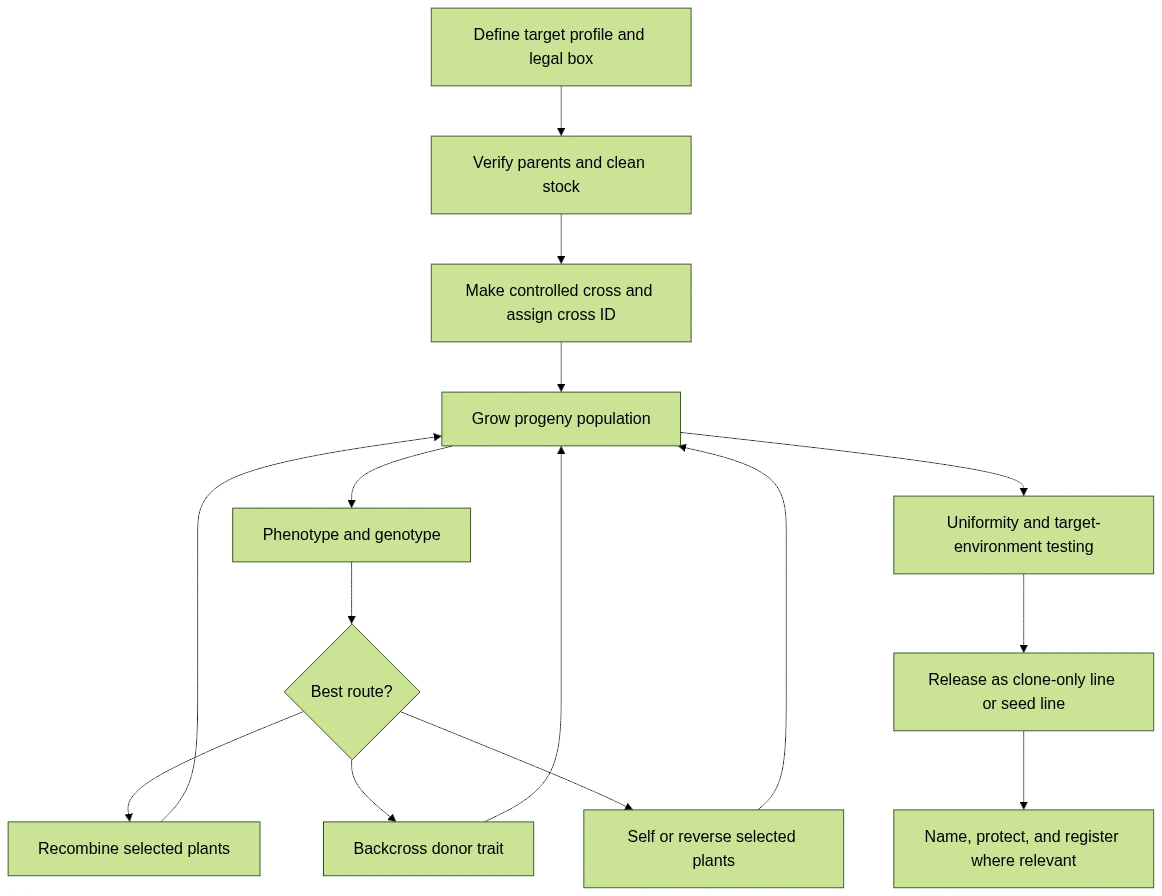
The timeline below is an approximation. Clone-only releases can move faster because the winning genotype is preserved vegetatively. Seed lines need additional generations because uniformity has to be built rather than simply maintained.
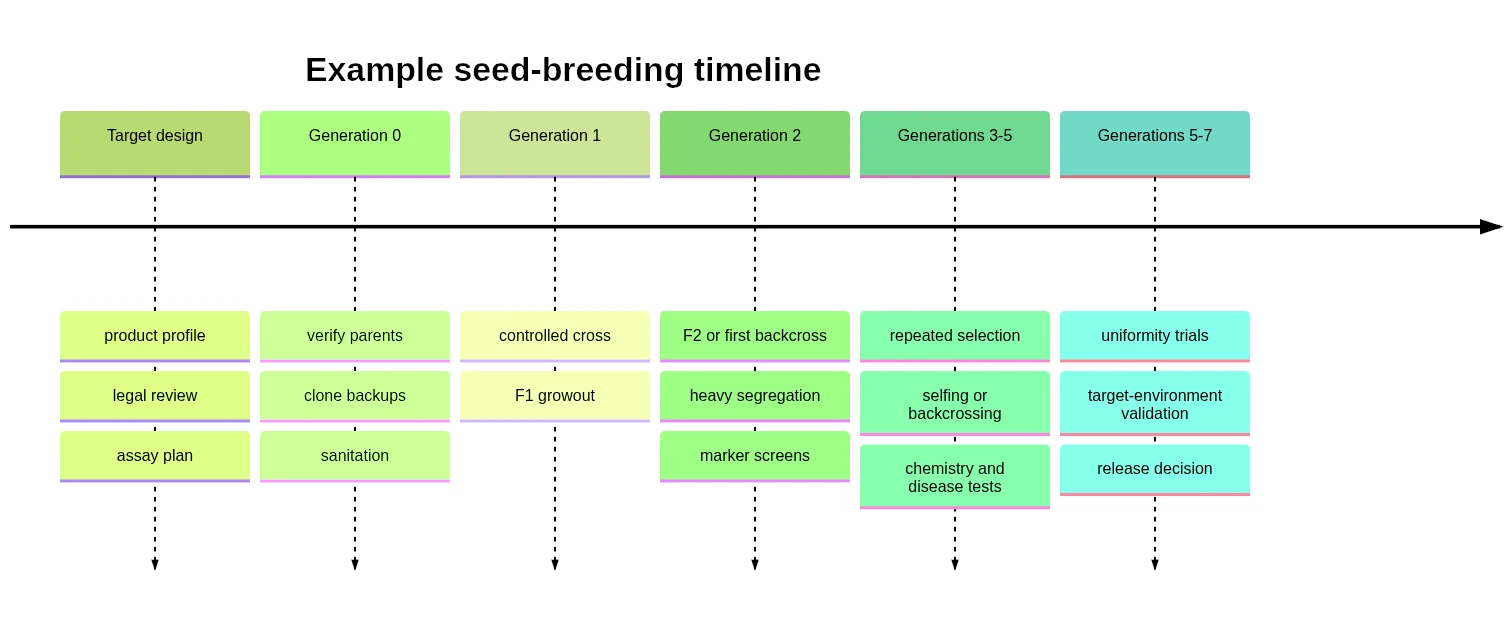
Typical stabilization timelines
| Release model | What must become reliable | Approximate generations | Practical reality |
|---|---|---|---|
| Clone-only elite | The genotype itself | 0–2 after elite discovery | Fastest path; consistency comes from cloning, not seed fixation |
| Backcross-derived line | Recovered background plus donor trait | BC3–BC5, then 1–2 confirmation generations | Strong option for moving one major trait into a preferred parent |
| Selfed / inbred seed line | Low segregation across the target trait bundle | S4–S7 is a common practical window | Earlier generations can still be useful, but they often throw off-types |
| Repeatable F1 hybrid | Two parents that each behave predictably | Parent development often takes several generations before hybrid production becomes repeatable | Hybrid release is only as good as parent stability |
| Polyploid-derived line | Fertility, chemistry, and structure across the new ploidy state | Highly variable; usually several cycles at minimum | Effects are too genotype-dependent to promise a fixed schedule |
These estimates synthesize classical selfing behavior, cannabis generation-time constraints, and formal ideas of stability and propagation mode. Outdoor hemp often moves one generation per year in the field, while controlled or in vitro systems can compress cycle time.
Practical operations and sample records
Cannabis is wind-pollinated, so controlled pollination starts with containment. The practical logic is simple: isolate males or pollen lots, isolate intended females or branches, label everything, and prevent unintended airflow or worker-mediated transfer between pollination and seedless production areas. That is not just a breeding preference. Fertilization in cannabis changes the crop itself: pollination and seed set reduce phytocannabinoid accumulation and alter terpene accumulation, which is why seedless flower systems guard so aggressively against stray pollen.
Pollen handling deserves more respect than it usually gets. Studies on cannabis pollen show that viability and non-abortion are not the same measure, and viability can decline quickly depending on handling conditions and assay system. The practical lesson is to validate your own storage and germination workflow for your own germplasm instead of assuming that “pollen in a tube in the freezer” is a stable, portable asset.
Record-keeping is what turns a hobby cross into breeding. Every planting should generate a cross ID, parent IDs, source lots, pollination date, operator initials, environment, measurements, lab results, cull reasons, and final selections. This is not bureaucracy. It is how you separate genetic signal from operator memory, and it is how you later defend a release, a patent, or a DUS filing if you choose to seek one.
Environment design matters because phenotype is conditional. At minimum, breeders should run common-garden comparisons. Better programs add replicated or multi-site trials in the target environment. Commercial R&D teams explicitly test lines across regions to estimate which traits are stable genetically and which are shifting under rainfall, temperature, and disease pressure. That is applied quantitative genetics, even when the company describes it in plain language.
Sample breeding record template
| Field | Example entry | Why it matters |
|---|---|---|
| Project code | CBD-EARLY-OUTDOOR-2026 | Keeps the program tied to a target product profile |
| Cross ID | 2026-CBD-014 | Prevents name confusion later |
| Objective | High-CBD, early finish, powdery mildew tolerance, open-field architecture | Keeps selection directional |
| Female parent ID | F-221 clone lot A | Preserves maternal identity |
| Male or pollen lot ID | M-077 pollen lot 03 | Preserves paternal identity |
| Parent evidence | Chemotype assay, flowering record, disease notes, marker calls | Justifies why the cross was made |
| Propagation backup | Mother clone archived in tissue culture and mother room | Protects irreplaceable parents |
| Pollination details | Isolated branch, date, operator initials, bag removed on day X | Creates an audit trail |
| Population size | 240 sown, 198 evaluated, 24 retained | Shows selection intensity |
| Environment | Greenhouse, then field site B | Links phenotype to growing context |
| Core measurements | Sex, date of flower initiation, date of maturity, height, stem diameter, biomass, disease score | Captures agronomic selection |
| Chemistry | THCA, CBDA, total cannabinoids, terpene panel | Captures product traits |
| Selection decision | Keep 12, clone 6, discard 180 | Makes culling explicit |
| Seed or clone storage | Seed lot weight, storage room, barcode; clone rack location | Preserves the breeding asset |
| Compliance and IP notes | License ID, THC test status, patent/PVP review, DUS candidate yes/no | Connects breeding to legal reality |
This template is a synthesis of breeder best practice, official DUS-style descriptors, and commercial R&D data discipline.
Case studies, pitfalls, and further learning
Three examples show how cannabis breeding has historically worked in practice:
First, breeder-reported history from David Watson (aka Sam the Skunkman) describes Skunk #1 as a three-way hybrid built from an Afghan × Colombian base later outcrossed with Acapulco Gold, with heavy selection for a shorter flowering window and lower segregation. Whether every downstream claim made in the market is exact is another question, but as a breeding case study it remains a classic example of hybridization plus stabilization for cultivation value.
Second, breeder reporting around DJ Short's Blueberry links it to material described as Thai, Chocolate Thai, Afghan, and Oaxacan, with the key detail being the process: extensive note-keeping, phenotype evaluation, and repeated work to make berry aroma and purple coloration reproducible. That is a useful reminder that a famous line is usually remembered for the cross, but built by the selection. Breeder-reported lineage histories like this one should be treated as historical accounts, not the same thing as a modern pedigree audit.
Third, the modern commercial example from Charlotte’s Web shows what happens when cannabis breeding moves from folklore to applied agricultural R&D. Company materials state that variable seed lots pushed the program toward proprietary hemp genetics, internal multi-site testing, and patented varieties optimized for product consistency, yield, disease resistance, uniformity, and phytochemical targets. That is less romantic than old strain lore, but it is closer to how mature crop breeding programs actually function.
The most common breeding mistakes are predictable:
- Trusting labels instead of verified plant identity. Genetic studies found substantial inconsistency within named strains and little support for broad market assumptions about shared “indica” and “sativa” phenotypes as a reliable genetic framework.
- Selecting in one environment and expecting universal performance.
- Allowing accidental pollination, which changes chemistry and product value.
- Narrowing too hard into one clone family, which can leave the program exposed to pathogens and viroids.
- Assuming a single technology solves everything: markers help where the genetics are simple; polyploidy can help in some backgrounds and fail in others.
For further learning:
- Read the domestication and breeding-history review by Clarke and Merlin for the long arc of the crop.
- Read Toth and colleagues on sex, chemotype, and flowering-time markers.
- Read Naim-Feil and Lapierre on phenotyping strategy and trait correlations.
- Read Adhikary and related tissue-culture reviews for clonal maintenance and modern propagation.
- Read the official UPOV guidance, the USDA Plant Variety Protection Office, or Health Canada guidance if you plan to protect, register, move, or commercialize breeding material.
Two limitations should stay in view. First, cannabis has made real progress on sex, chemotype, flowering time, and some disease loci, but terpene genetics, minor-cannabinoid breeding, and durable resistance packages are still much less mature than breeders often imply. Second, many famous lineage stories remain breeder-reported histories rather than genomically verified pedigrees. Good cannabis breeding today respects both facts.